
It's interesting that many paving projects you encounter often overlook the critical role of durability in frost-resistant block paving. When subjected to freeze-thaw cycles, materials can show varying levels of performance based on their composition and treatment. You'll want to understand how certain standards and material factors come into play. The implications of these test results could greatly impact the longevity and maintenance of your paving choices moving forward.
Key Takeaways
- Testing according to DIN EN 1338 allows for scaling rates up to 1,000 g/m² after 28 cycles, indicating frost resistance.
- ASTM C936 evaluates freeze-thaw durability under de-icing salt exposure, essential for frost-resistant block paving.
- Minimum density of 1,500 kg/m³ is vital for frost resistance, enhancing durability and performance.
- Proper base preparation and drainage significantly reduce the risk of damage from freeze-thaw cycles.
- Regular maintenance, including inspections and cleaning, is crucial for sustaining the durability of frost-resistant block paving.
Overview of Freeze-Thaw Testing Standards
When evaluating the freeze-thaw resistance of block paving, it's important to understand the standards and methods that govern testing procedures.
Key testing methodologies include DIN EN 1338, which specifies a slab test allowing scaling rates up to 1,000 g/m² after 28 cycles. ASTM C936 also addresses freeze-thaw durability, incorporating de-icing salts.
The CDF test is more stringent, yielding scaling rates 1.35 to 5 times higher than the slab test. Conversely, ASTM C1262 faces criticism for its repeatability issues, while ASTM C666 examines smaller specimens.
It's vital to take into account sampling methods, the choice of de-icing agents, and climatic conditions, as they greatly impact scaling rates and overall assessment of freeze-thaw resistance in concrete pavers.
Impact of Freeze-Thaw Cycles on Material Durability
As freeze-thaw cycles repeatedly stress materials, their durability often diminishes considerably, impacting various types of paving systems.
You'll notice that traditional paving experiences cracking and heaving, leading to structural instability and safety hazards. The freeze-thaw effects accelerate wear, reducing longevity and increasing maintenance costs.
Concrete block paving isn't spared either; it suffers from surface loss and cement paste scaling, particularly when water saturation occurs.
Composite materials display a significant loss in flexural strength and rigidity, raising concerns about long-term durability.
These vulnerabilities highlight the importance of evaluating material resilience in freeze-thaw conditions to guarantee effective performance and minimize costly repairs in the future. Proper drainage and installation techniques are essential for mitigating these adverse effects, as permeable block paving can significantly enhance water management and reduce freeze-thaw damage.
Key Material Factors Influencing Performance
Understanding the key material factors influencing the performance of block paving is essential, especially in the context of freeze-thaw cycles that can greatly impact durability.
The material composition, including a minimum density of 1,500 kg/m³ and a compressive strength of 7.3 N/mm², is crucial for frost resistance. Incorporating air-entraining agents and supplementary cementitious materials enhances performance by accommodating water expansion.
Environmental factors, such as saturation risk and exposure to wind-driven rain, necessitate using medium-dense or dense blocks. Proper curing conditions and porosity control further contribute to minimizing frost damage. Additionally, high resistance to stains ensures that the surface integrity is maintained even under challenging weather conditions.
Real-World Durability of Block Paving
While various factors influence the real-world durability of block paving, the interplay between installation techniques, environmental conditions, and usage patterns is essential.
Proper base preparation and drainage systems are crucial for longevity, reducing the risks associated with water buildup and erosion. User testimonials often highlight how professional installation prevents common issues like poor alignment, ensuring stability over time. Additionally, implementing proper drainage solutions can significantly enhance the performance of block paved driveways.
Environmental factors, including freeze-thaw cycles and exposure to de-icing salts, greatly impact durability in real-world applications. Additionally, understanding traffic load and distribution informs material selection, optimizing lifespan.
Ultimately, careful consideration of these elements leads to enhanced performance and durability, making block paving a reliable choice for various settings.
Maintenance Practices for Longevity
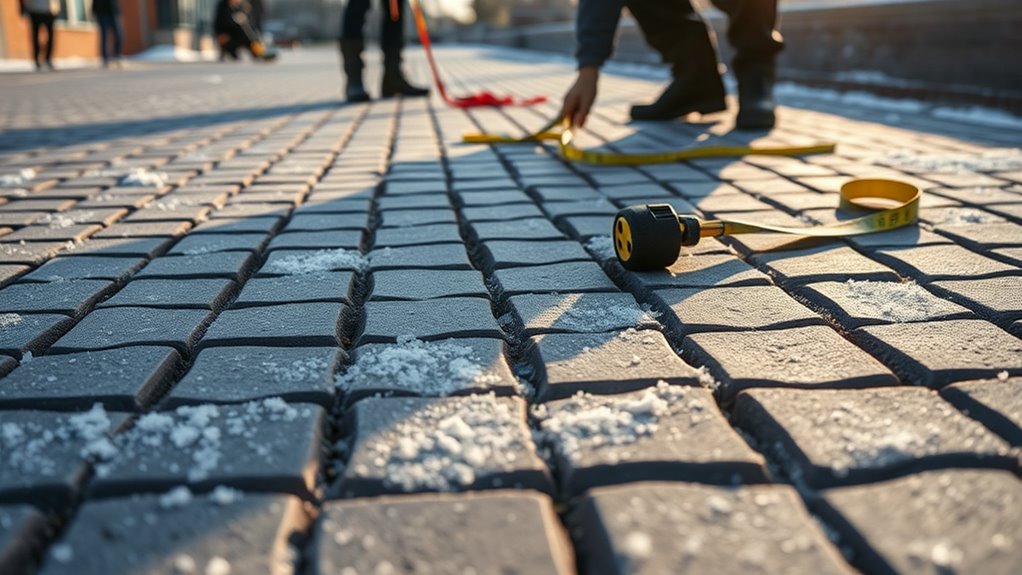
To guarantee the longevity of block paving, regular maintenance is critical in preserving its functionality and aesthetic appeal.
Implement effective cleaning techniques by regularly sweeping the surface to remove debris and dirt. Pressure washing can be useful but should be approached cautiously to prevent joint sand erosion. For deeper cleaning, consider power washing while ensuring you don't damage the blocks.
Weed prevention is equally important; inspect for and remove weeds promptly to maintain stability. Use weed killers safe for your paving materials, and consider hand removal to avoid damage. Additionally, applying weed barriers can further reduce infestations. Regular inspections for signs of damage will help ensure timely repairs and overall durability.
Through consistent cleaning and vigilant weed control, you'll enhance the durability and appearance of your block paving over time.
Insights From Durability Test Results
Durability test results reveal critical insights into the performance of block paving, particularly concerning its frost resistance. The findings emphasize that proper installation, quality materials, and environmental conditions play pivotal roles in longevity. Block paving can endure freeze-thaw cycles effectively, showcasing its resilience against harsh weather. Additionally, the incorporation of permeable block paving facilitates effective water drainage, further enhancing its durability in frost-prone environments.
| Test Factor | Observations | Implications |
|---|---|---|
| Porous Nature | Allows effective drainage | Prevents water accumulation |
| Cement Content | Affects durability outcomes | Lower content may weaken structure |
| Freeze-Thaw Cycles | Withstands up to 50 cycles | Suitable for frost-prone areas |
| Maintenance Practices | Regular care extends life | Essential for long-term durability |
Frequently Asked Questions
What Specific De-Icing Chemicals Are Used in Tests?
In tests, you'll find sodium chloride, calcium chloride, and magnesium chloride commonly used. These de-icing methods exhibit various chemical effects, influencing scaling rates and overall durability of materials under freeze-thaw conditions.
How Does Specimen Age Affect Test Results?
Notably, specimens subjected to five freeze-thaw cycles exhibit surface loss. You'll find that specimen maturity and aging effects don't greatly impact durability; material properties play a more vital role in determining performance throughout testing.
Are There Different Standards for Different Regions?
Yes, regional standards vary considerably due to climate variations. You'll find specific requirements for frost resistance that reflect local weather conditions, ensuring materials perform at their best under different environmental stresses across various regions.
What Is the Lifespan of Frost-Resistant Block Paving?
Imagine a well-maintained driveway lasting over 30 years. Lifespan factors like frost resistance and effective maintenance practices, including regular cleaning and timely repairs, greatly influence the longevity of frost-resistant block paving in various climates.
Can Freeze-Thaw Tests Predict Actual Performance in All Climates?
Freeze-thaw tests can't universally predict performance across all climates due to climate variability. You must assess specific performance metrics, as real-world conditions often differ markedly from controlled testing environments, influencing actual material durability and effectiveness.
Conclusion
In summary, adhering to the standards like DIN EN 1338 and ASTM C936 can transform your block paving into an indestructible fortress against the harshest freeze-thaw cycles. The durability test results reveal that density and compressive strength are essential for peak performance, while air-entraining agents add an extra layer of protection. By implementing effective maintenance practices, you'll guarantee your paving remains resilient and safe for years to come, standing strong through whatever nature throws its way.

Adding curb appeal to your home can be a daunting task, but it doesn't have to be. Designing and installing Read more

As homeowners, we are always looking for ways to improve and add value to our properties. One popular choice for Read more

Block paving, like a well-tended garden, is a testament to the care and attention given to one's property. Just as Read more